
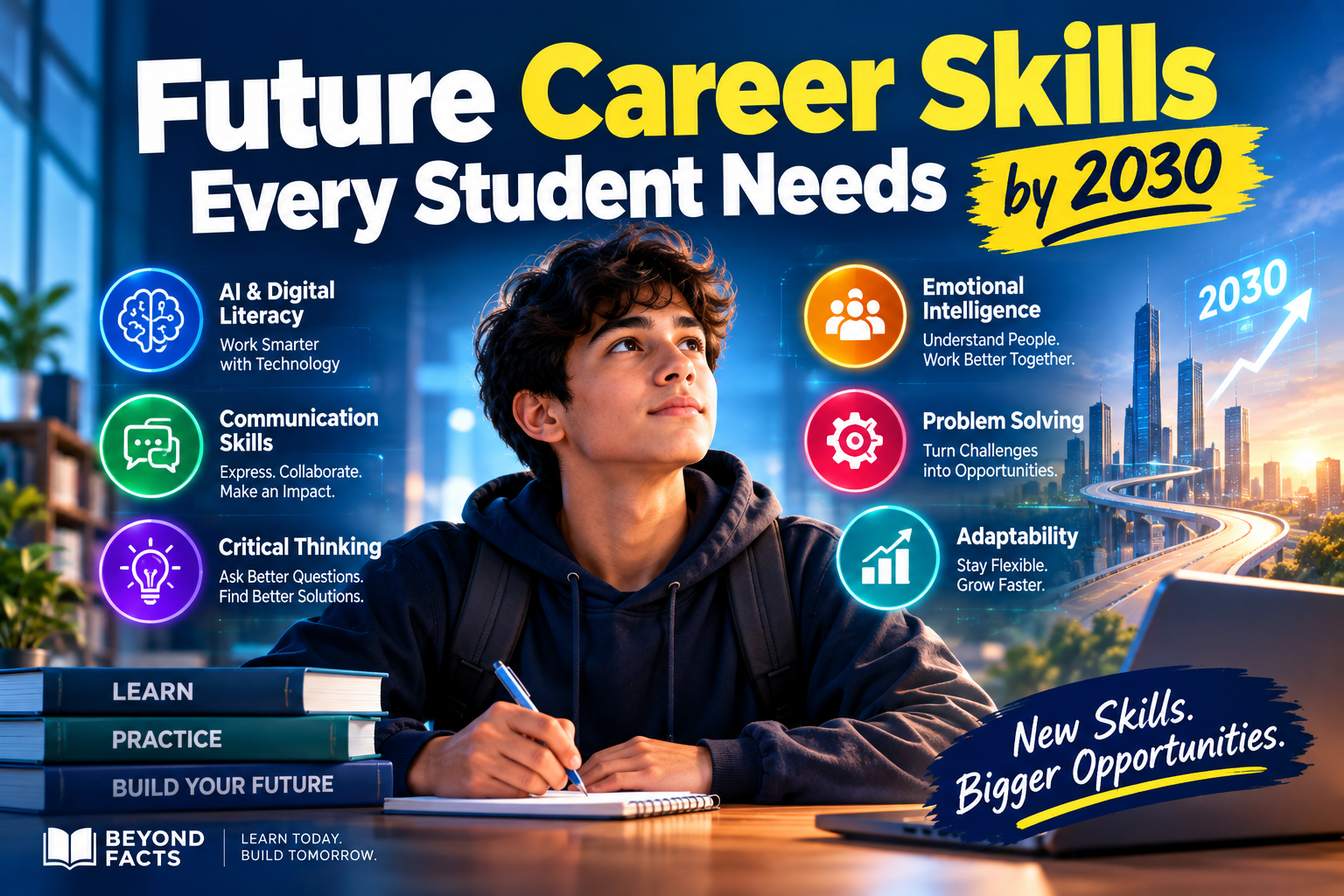
The job market students are walking into in 2026 doesn’t look like the one their parents entered — and it’s changing faster than most people realize. According to the World Economic Forum’s Future of Jobs Report, generative AI, the green transition, and other major shifts are expected to create 170 million new jobs by 2030, while displacing 92 million existing ones. Nearly 40% of the skills workers currently rely on could change or become outdated by 2030.
That’s not a reason to panic — it’s a reason to be intentional. Here’s what’s actually happening in hiring right now, and which skills genuinely matter if you want to stay competitive over the next several years.
How Hiring Itself Is Changing
One of the biggest shifts isn’t a specific skill at all — it’s how employers are evaluating candidates. Skills-based hiring has become mainstream: a large majority of employers now report using skills-based hiring practices, up notably from the year before. In practice, this means employers care less about which university logo is on your degree and more about whether you can actually demonstrate the skill in question — with concrete examples of situations where you used it to solve a real problem.
This shift has a direct implication for students: a strong GPA and a diploma alone are no longer enough. Employers are increasingly looking for a portfolio of real experience — internships, projects, competitions, part-time work — because experience is what actually gets tested in interviews now, not just credentials on paper.
AI Fluency Is Now a Baseline Expectation, Not a Bonus
AI is becoming an expected competency for early-career roles across almost every field, not just tech. A meaningful share of entry-level job postings now explicitly mention AI skills, and that share is climbing every year. Here’s the important nuance though: most employers aren’t looking for AI engineers or machine learning researchers. What they actually want is far more accessible — professionals who can use AI tools effectively, evaluate AI-generated output critically, and apply AI to improve real business results.
The specific AI-related skills showing up most often in employer surveys include:
- AI literacy — understanding what these tools are actually good at (and where they fail)
- Prompt engineering — knowing how to get useful, accurate results out of AI tools
- AI-powered data analysis — using AI to work with and interpret data faster
- Workflow automation — using AI to remove repetitive manual work
- Ethical AI decision-making — knowing when human judgment should override an AI’s output
Notice that none of these require a computer science degree. They’re accessible to students in business, healthcare, communications, or almost any other field.
The Skills That Still Never Go Out of Style
It’s tempting to think every future skill has to be technical, but that’s not what the data shows. Some abilities remain valuable precisely because they’re hard to automate — companies will always need people who can lead teams, communicate clearly, and guide projects to completion. Employers consistently rank these “durable” human skills — problem-solving, adaptability, communication, and leadership — right alongside technical skills like data literacy and AI fluency, not as an afterthought.
The strongest profile for the next decade isn’t “purely technical” or “purely soft skills” — it’s a mix. A student who understands data, uses AI tools competently, and can also communicate ideas clearly and work well with others is significantly more valuable than one who’s strong in only one dimension.
A Practical Starting Point
You don’t need to master everything at once. A reasonable approach for any student, at any level:
- Pick one AI tool and actually get comfortable with it — not just using it, but understanding its limitations and how to check its work.
- Build a small portfolio of real examples, even informal ones — a school project, a volunteer role, a small freelance gig — that shows a skill in action rather than just claiming it on paper.
- Practice explaining your thinking, not just your answer. Being able to walk someone through how you solved a problem is increasingly what interviews and skills-based assessments are testing for.
- Stay genuinely curious about how your intended field is changing. Whether you’re headed toward business, healthcare, engineering, or the arts, AI and data are touching almost every industry now — knowing how they’re being used in your specific field gives you a real edge over students who only think about it in the abstract.
The Bottom Line
The future job market isn’t going to reward students who memorized the most information — it’s going to reward students who can apply what they know, adapt quickly, and work comfortably alongside AI tools rather than either ignoring them or over-relying on them. Starting to build these habits now, well before graduation, is the single biggest advantage a student can give themselves heading into 2030.